I Know Better But I Do It Anyway
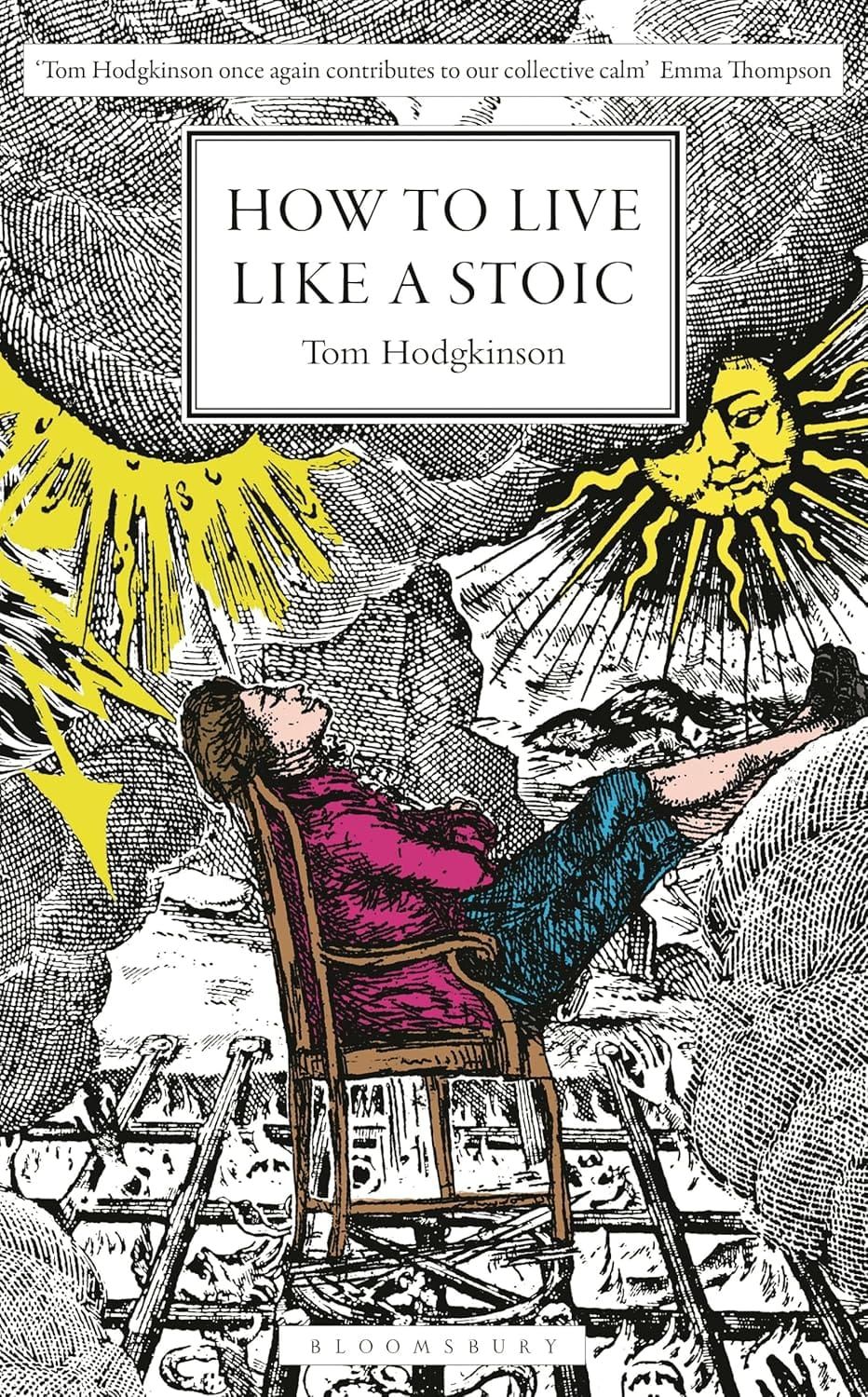
How To Live Like a Stoic
Tom Hodgkinson
Bloomsbury | May 2026 | 207 pages | Hardcover
I’ve been running on a sprained ankle, deliberately disobeying a doctor’s orders just because I can.
Some contemporary branches of Stoicism—specifically, the ones advocated by tech bros and the snake-oil-salesmen who slither around the manosphere—might salute me for my courage. That I know myself better than someone who spent eight years studying the human body. But I’ve made what was a relatively benign situation worse by not following sound medical advice. Socrates, that most Stoic of Stoics, might say I am being haunted by my daimonion—literally, a little divine thing—or what we today call our inner voice. The Sage of Athens believed that the absence of this inner voice served as permission to continue doing whatever he was pursuing. Famously, during his trial in which he was sentenced to death for refusing to recognize the gods of the state, he explained that he never got into politics because his daimonion wisely advised him against it. Mine, it appears, needs to get better at blocking my harmful impulses to lace up.
I know better than to run on a wonky ankle, yet I do not act on that knowledge. The Greeks called this akrasia, the state of acting against one’s sound judgment. So perhaps my daimonion is doing what it’s supposed to, but I’m better at overriding those thoughts. A part of me enjoys the override. “Know thyself,” apparently, cuts several ways.
To heed one’s daimonion is to acquiesce to one’s rational or moral compass despite overwhelming temptation to do otherwise. My struggle with obsessive running, I recognize, will be lifelong and likely never fully resolved. But I admit my wrongs and am (almost) ready for a change. The ancient Stoics might applaud my feeble attempt at transformation, but they would also tell me that to live as a full-time Stoic is not for everyone—it’s the little, everyday encounters where we might incorporate Stoic teachings that make a difference for a pleb like me.
And it is for people like me that Tom Hodgkinson has written How To Live Like a Stoic. As editor-in-chief of The Idler, a British magazine founded in 1993, Hodgkinson has devoted his career to deliberately rejecting the modern cult of productivity, arguing that busyness is a modern form of tyranny. To combat it, Hodgkinson and his merry band of Idlers (his co-founder Gavin Pretor-Pinney created the Cloud Appreciation Society) prescribe leisure as defined by reading, thinking, and conversation as the antidote to the enslavement of ambition. This book is the latest in a string of titles which make the case for a slower and more deliberate life rooted in classical thought and caring for those around us.
Stoicism is enjoying a revival: in 2012, Penguin Random House reported sales of 12,000 copies of Marcus Aurelius’s Meditations—hardly nothing, especially for a work nearing two thousand years old—but in 2019, that number jumped to 100,000 copies sold, perhaps in response to overwhelming feelings of helplessness in a world untethered to accepted norms. So, you might not be able to control politics, but you can find contentment by focusing on that which is squarely within your power through your words and deeds. It is a seductive mantra and has been repeated throughout pop culture over the past 50 years: “Let It Be” by the Beatles, as Hodgkinson points out, is a Stoic ballad of accepting those things that cannot be changed and of finding peace in surrender. If only I could heed the advice of Sir Paul. Several such examples pepper the book, making surprisingly light work of what could otherwise be a dry and difficult topic for lay readers.
The Stoic legacy survives today due in large part to Ryan Holiday, a student of classical philosophy and a bestselling commercial evangelist whose work has long emphasized personal optimization over the civic obligation intrinsic to leading a true Stoic life. I’ve certainly become victim to the push-through mentality that dominates modern life (thank you, Strava), and I’m living the consequences of my actions in the form of boring PT and being fitted for orthotic inserts. But that’s the superficial view. I’ve also failed running friends, one whom I’ve been supporting in his quest for a 100-miler, because now I’m unavailable to share some of the lead-up prep. The optimization framework doesn’t see this cost because it’s entirely focused on individual performance. Did my friend need me to be there at every run? Ultimately, he’s the one who’s got to put one foot in front of the other, but until now I’ve been a reliable training partner, and my override impulse betrayed that.
Stoicism has also been perverted by businesses that rebrand poor working conditions into a culture of resilience. Select interpretation of the philosophy conveniently absolves management of any duty to workers. Consider Amazon, where leadership principles solemnly declare that “everybody at Amazon is expected to be an owner…” – stirring stuff from a company whose warehouse injury rates are a matter of public record. Mindfulness workshops, no surprise, make for cheaper HR than providing living wages.
Each of Hodgkinson’s seventeen chapters focuses on a different Stoic principle—love, anger, education, politics, pain—and how we in the modern world might apply those teachings. For example, the ancient world was a painful place, if Seneca, in his letters to Lucilius, is to be believed; so, it turns out, is the modern one. “Scorn the pain! It will be over soon,” writes Hodgkinson. And maybe learn something from it: he wonders how things might have been different if the Sackler family had taken a more Stoic approach and not pushed OxyContin on millions of people like Appalachian mine workers who could then “carry on working even though their body was telling them to stop.”
Fine. If I can feel the pain, should I be indifferent to it? It doesn’t take the sting out of being sidelined. In the meantime, I have stopped judging other people’s mile splits because this indulgence, I now see, is a stand-in for vexation with my inadequacy. Cicero, when mourning the untimely death of his daughter, sought refuge in Stoicism, not as an instant-optimization cure for his grief, but as a balm to, someday, heal his soul. The scale differs, obviously. But the principle holds. If this all sounds vaguely like cognitive behavioral therapy, you're on to something: as a direct descendant of Stoicism, the coping strategy encourages patients to “accept the world as it is rather than try to change it.”
But whether we choose to follow the path of the classical version or not, most Stoics believe it is nearly impossible to live a truly, completely Stoic life. Seneca suggests that there are three levels of Stoicism, with Level One akin to attaining Nirvana. Most of us would be thrilled to even think about approaching Level Three, where adherents still emote, still feel pain. And yet, Seneca says that most of us won’t even get there, that “it is sufficient achievement to us if we are not among the worst.” And further, if everyone were Stoic, no one would be miserable because we’d all float along in perpetual contentment. Who then, would write the great tragedies and sad love songs?
One piece the moderns leave out is that to be Stoic is to be an active participant in civic life–jury duty, military service, attending theater and drinking with friends. Sounds suspiciously like what we might call a life of leisure, but for the Greeks, the word suggested a life dedicated to learning. And no one would really call Cicero a man of leisure.
Humane and funny, Hodgkinson offers both a corrective and companion in uncertain times—our very own Virgil guiding us through the Hell of modern-day Stoicism and into the Purgatory of trying to live like a real one. He doesn’t promise we’ll get out.