Still Very Much Alive
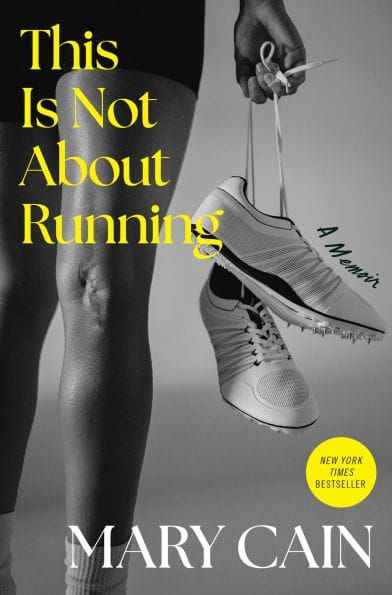
This Is Not About Running
Mary Cain | April 2026| Mariner Books | 336 pages| $29.99
There is a moment in the preface of Mary Cain's memoir, This Is Not About Running, when the author lashes out at her former sponsor and source of much of her troubles:
Nike loves Steve Prefontaine because he’s dead. They have immortalized his face in ads….I sometimes wonder if I had killed myself, how much the running world would have pretended to care.
Cain does not suggest she’d “get the Pre treatment”—she’s still a girl, after all—and cruelly estimates the half-life of her earnings value as a dead runner to about a week. Nike is merely the last in a line of people and organizations who failed to protect her.
For the most part, Cain’s been the only one to stand up for herself, remarkable because this is about a girl who became a professional runner at the age of seventeen, only to retire in 2016, at the ripe old age of twenty, broken in all manner of ways. She reappeared with a scathing video op-ed in 2019 for the New York Times where she detailed the physical and mental abuse endured at the hands of her male coaches, including Nike’s Alberto Salazar, architect of the Oregon Project. In This Is Not About Running, Cain turns a story we thought we knew into a tightly crafted indictment of the youth-sports machine, told with a measured fury that makes it a necessary and genuinely good read.
Cain is, sadly, only the latest female professional runner to come out in recent years to call out the cruelty and abuse rampant in their field. One that comes to mind in particular is Lauren Fleshman’s Good for a Girl, but the anger is palpable here. Both serve as manifestos for a system in desperate need of change. Both women were Nike athletes, but Cain’s age when it happened makes this account riskier and more intimate.
Cain chose to tell her story in the present tense “to show how subtle and slow-burning the normalization of abuse is over time.” Cain is a talented, careful writer and she has taken pains to account for her own blind spots—she now wishes she “had given [herself] more time to process” before publishing her op-ed in 2019, for example—but victims of abuse “don’t owe anyone else” their healing journey. This retelling makes it difficult for critics to argue “she should have seen this coming” or “where were her parents” because we see what she saw in that moment. Whether intentional or not, the reader is spared the easy satisfactions of victim-shaming, something Cain has fought her entire career. But it does encourage self-reflection: the mother who pushes her child too hard at youth sports, the father who relents to a coach insisting on more practice time at the expense of academics.
Mary Cain burst onto the running scene in the 2010s, an adolescent phenom, fully formed like Athena, ready to battle her competitors. She excelled at the middle distances and by seventeen was one of the few women to run the 800m in less than two minutes. All the while, Cain was essentially alone as she endured bullying from parents, fellow high school teammates, and coaches. Cain maintains a surprisingly stoic attitude, but there is only so long someone can endure, and eventually she is overpowered by pressures to be thin, to be beautiful for Nike ad campaigns, and to please Salazar. Winning races, it seems, becomes a secondary goal.
Cain calls her own shots—“headstrong” might be an understatement—whether competing at the New York State Championships or deciding to launch her professional career before turning eighteen. But her athletic life begins in the pool as a talented swimmer, where camaraderie and confidence are the norm — a control group for what comes next. On the track at Bronxville High School, her talent is perceived as a threat. Coach Jim Mitchell plays favorites and mind games and lards practice talk with puerile conversations about parties and sex, and parents who pin love and Olympic dreams on their daughters jeer that Cain isn’t a “team player”—code for letting other girls win. At a Van Cortlandt Park race, several fathers run onto the wooded course to pace their daughters, an automatic disqualifier, while administrators, pleading powerlessness, refuse to hang the banners Mary wins.
Later, Cain bitterly concludes that “most runners only like you if you’re slower than them,” which suits Alberto Salazar's “us against the world" mentality perfectly, allowing him to manipulate her to the point of mental and physical destruction. After his own brilliant running career, Salazar became the head coach of Nike’s Oregon Project with the goal of bringing global glory back to American professional running. During her time with Nike, Cain devolved into undiagnosed depression, an eating disorder, and self-harm. She met regularly with Darren Treasure, described as a sports psychologist but not licensed as one. Instead, he shared details from their sessions with Salazar, who used that information to pit teammates against one another.
Off the track, Salazar is Cain’s Svengali, her stand-in father. She only exists to please him. Her public weigh-ins become barometers of his affection for her. She often stayed at his home in his daughter’s bedroom (without his wife or daughter present, despite telling Cain’s parents the contrary) and he would come into her room at night and watch her while she feigned sleep and hoped he would leave. On the page, these violations accrete as “normal,” until the night visits and frequent weigh-ins read as body surveillance in service of a brand. (In 2021, Cain filed a $20 million lawsuit against Nike and Salazar, alleging severe emotional and physical abuse. The suit was settled in 2023 for an undisclosed amount.)
Eventually, Cain summons the courage to go home after intense shin pain that won’t go away. Salazar has her get an MRI but says nothing’s terribly wrong. The pain never relents, and when Mary’s father, a doctor, takes her for a second opinion, they’re shocked that a previous MRI did not reveal a stress fracture. In fact, it did, but was never shared. At the end of the book, in the section called “Champion,” Cain lists all her medical diagnoses that have plagued her, rather than her accomplishments on the oval. Here again, the abuse has been incremental, and the withheld MRI is a final betrayal more than a twist. Inside the Oregon Project, incentives surrounding times and coach prestige reframe this neglect as “normal.” What those coaches were hoping to eke out of her can only be seen as abuse.
One wonders how Cain’s Bronxville teammates—now perhaps mothers themselves—might have turned out differently with a better coach. It is a cycle Cain has decided to break. For her part, Cain is in medical school at Stanford and runs Atalanta NYC, placing professional female runners in front of young women from underserved New York communities.
Nike may immortalize the dead, but Mary Cain is very much alive, no longer waiting for the sport to protect her, but building communities that may help other girls who simply want to run fast.