Form and Function
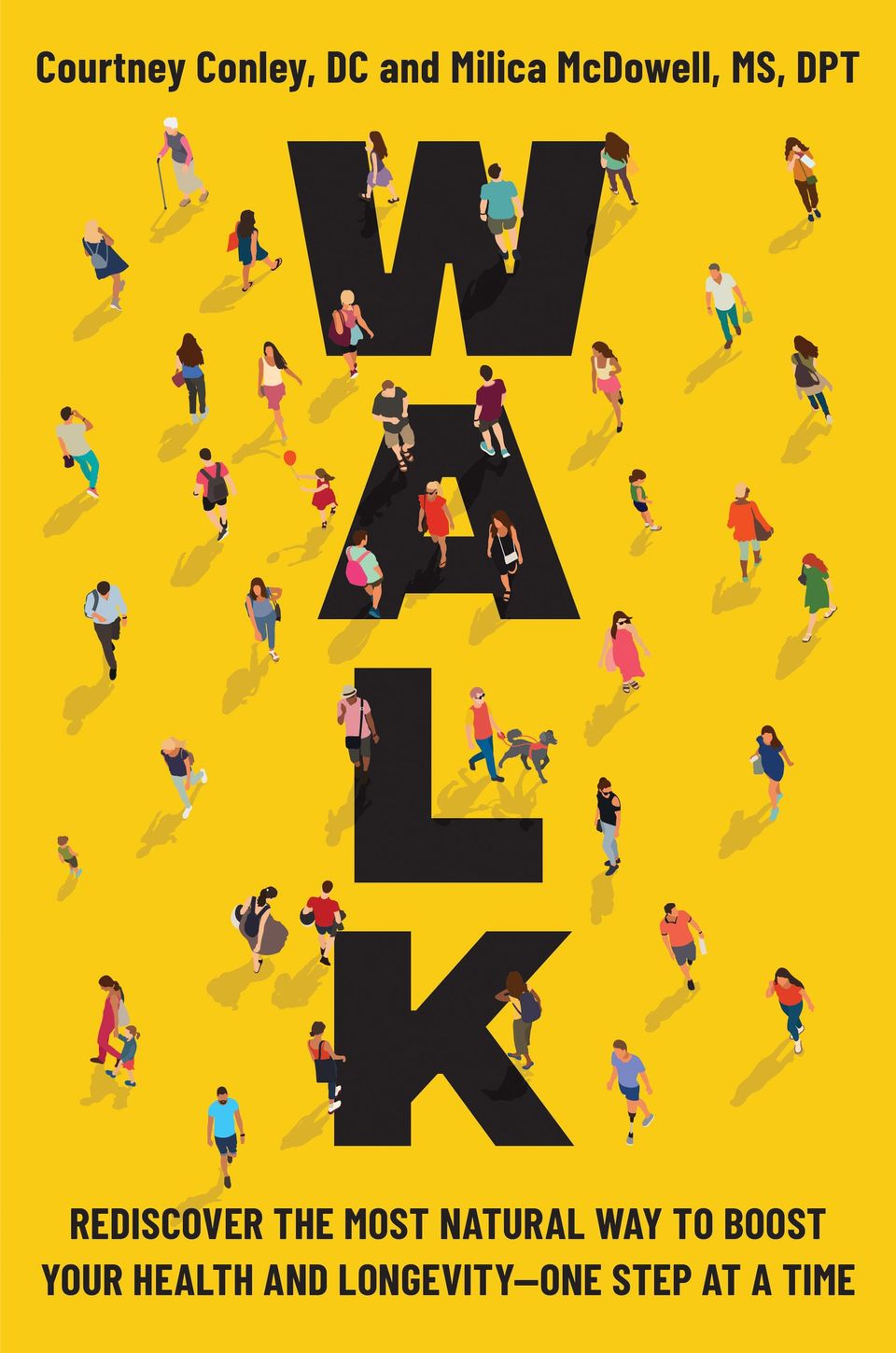
Walk: Rediscover the Most Natural Way to Boost Your Health and Longevity—One Step at a Time
Courtney Conley, DC, and Milica McDowell, MS
Balance | May 2026 | 334 pages | Hardcover
"I come from a long line of fast walkers," breezed my then-boyfriend's mother as I puffed to keep pace with her along Les Champs-Élysées where Parisians who stroll are known as flâneurs—people who walk with no purpose. Debbie was no flâneuse, and twenty-five years later my mother-in-law is showing no signs of slowing down. Could she and her fellow belles of the Bronx's Grand Concourse have good genes or did their lifelong walking habit have anything to do with it?
A new book by Dr. Courtney Conley and Milica McDowell says yes, emphatically. By now we’ve all heard how we’re committing ourselves to an early grave if we sit too much. Walking more will keep us spry and our brains firing. And athletes can be the most sedentary creatures of us all: how many of us convince ourselves that we’ve deserved to lounge on the couch all Sunday after our epic early morning long run? I might argue that if your long run is over four hours, you’re probably exempt from scorn, but Walk counters that incorporating more walking, even for active people, will make it easier to reach or exceed weekly mileage goals without the high-impact pounding that comes from running.
It’s this last point that drew me to the book. Strava irritates me because my accumulated mileage only records what I do running. It doesn’t include walking or hiking. I’m sure there’s a setting to fix this, but I haven’t found it yet. In the interim, I’m bummed I can’t gamify my walks because I’m unnecessarily competitive and I want the credit. A brisk walk does the same metabolic work but with Debbie’s heart-healthy New York swagger. And I can’t be the only one who’s self-inflicted an injury or ignored one for too long only to be told by the PT to do the boring exercises and run less. Walking helps heal injuries quicker and keeps you sane while you’re sidelined.
Bucking current shoe trends for maximum cushion and high-stack height, Walk encourages minimal shoes that mimic a foot’s natural shape. This isn’t exactly as fresh a take as the book alleges—runners have been arguing about this since the barefoot running trend of the noughties. After a decade of marshmallow-soft sneakers, some shoes are starting to deflate now (Hoka!), but plenty of running shoes with skyscraper stack height persist (ASICS!). A shod foot that’s closer to its natural state will be more resilient.
The authors are confident and practical to a fault, which makes Walk effective for getting readers to actually do the exercises. Exercised by Dr. Daniel Lieberman immediately springs to mind as a complementary text. His is not a self-help book, but I find myself returning to the Harvard professor’s work because he provides the evolutionary thinking that reframes how I understand movement—the why that explains how my body responds to walking. But I need Conley and McDowell to know how to transition out of my Hokas without wrecking my feet.
So, should we banish our stacked kicks in favor of Altras? Some of us did that during the barefoot boom too quickly and ended up in more pain than before. Walk offers a transition protocol that could easily be adapted to runners as well. Any progress towards a more natural foot position, whatever that may be, will make for stronger toes and a healthier long life.
And really, if all the book does is get you to walk more and with greater focus on your form, you just might give Debbie a run for her money. Maybe. She’s probably been doing this longer than most of you.