Mythbusting
The Long Run: Steve Prefontaine, Frank Shorter, Joan Benoit, Grete Waitz, and the Decade That Made the Marathon Cool | Martin Dugard | Dutton | 306 | $32
In 1970, on a hot morning in the middle of September, one hundred and twenty-seven runners paid the one-dollar entry fee for the privilege of running a few loops through Central Park at the first running of the New York City Marathon. Fifty-five runners finished, with wristwatches awarded to the first ten, clocks to the next thirty-five, and finishers’ trophies festooned with Lady Liberty for everyone else. Barely any bystanders realized there was a race underway. It was not an auspicious start. When the race expanded to wind through all five boroughs six years later, Marathon Day became a spectacle millions could witness from their own street corner, and soon, more of those spectators joined in. By 1977, one in eleven Americans called themselves a runner. By 2025, over 200,000 runners applied for the New York City Marathon, and only 2% received bibs. Viva la boom, but Martin Dugard’s argument in The Long Run is that the running boom was a campaign built over centuries, by runners, promoters, dreamers, and people who just loved the sport. Dugard makes the case with an infectious delight, more celebration than exposé.

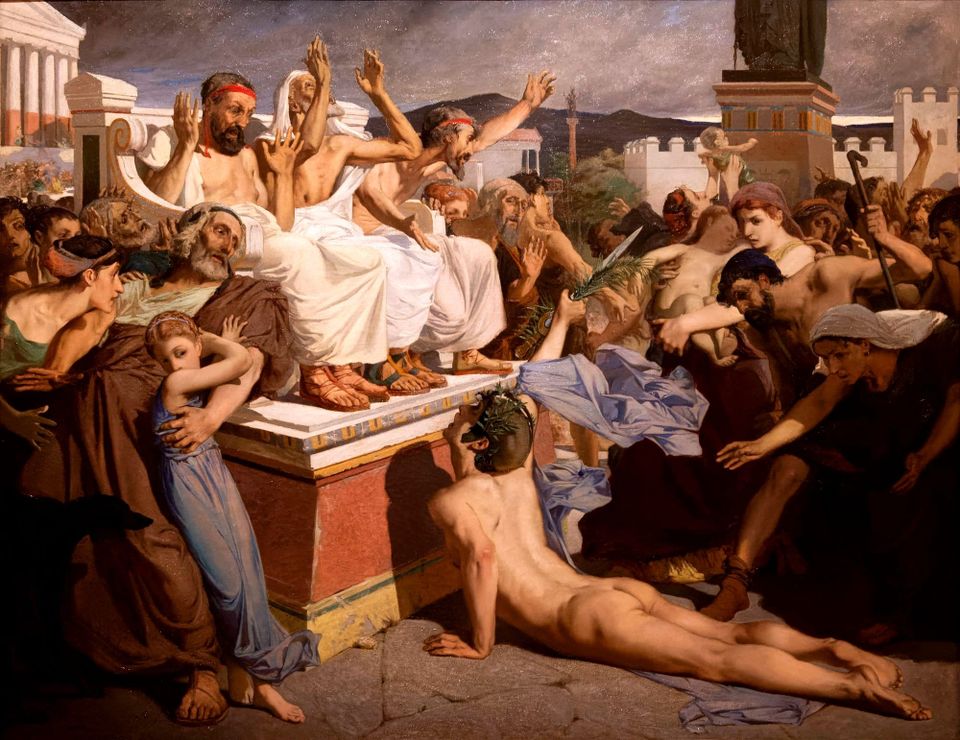
Humans have run since time immemorial, but to show how the marathon became what it is, Dugard starts at the Battle of Marathon, where the Greeks faced an existential threat in the Persian army. The legend is familiar: Pheidippides runs to Athens crying “Nike” (victory) and drops dead. Except, Dugard points out, that conflates myth with legend. Writing sixty-five years later, Herodotus has Pheidippides run first to Sparta for help, then to Athens, meeting the god Pan along the way, a god many Athenians credited with the victory. No triumphant collapse anywhere. Five hundred years later, Plutarch retells the story without Pheidippides at all. Thank Lucian decades after that for supplying the famous death cry. Was this a Syrian satirist poking fun at the Greeks, or a savvy writer juicing an old story? Either way, the version we know is Lucian’s. Robert Browning’s 1879 poem “Pheidippides” put it into English verse, and it’s been the standard ever since. Dugard’s point lands: mythmaking has been braided into running from the start. And knowing that, how many of us will still channel the poor Greek messenger when we’re lamenting a grueling 18-miler?
Even the sport’s founding myths weren’t built by runners. They were built by men who wanted something else out of the race. We’ve all heard that the marathon was extended to 26.2 in 1908 because the British monarchy wanted a better view of the finish line and so tacked on two miles. In Dugard’s telling, that honor goes to race director Lord Desborough, who hoped the move would convince King Edward VII to serve as the official starter. He struck out with the king, but Princess Mary was available, so even though she had nothing to do with the extra mileage, she gets the blame. It’s more fun to curse a royal for those extra miles than a race organizer.
Participation stayed, in Dugard’s words, “tepid,” well into the 1970s, but the groundwork for a boom was being laid. Bill Bowerman’s 1963 jogging group grew so popular he was soon dispatching acolytes to spread the gospel of regular physical activity. Even JFK had a hand in it: his challenge to Americans to prove themselves heirs to the frontier spirit and, practically speaking, ready to fight the Soviets if necessary, helped launch the JFK 50 Mile, which still runs today. Running was a civic duty as much as a form of exercise.
Frank Shorter’s 1972 Munich victory—effortless-looking, even if it was anything but—got people excited about trying it themselves, in Dugard’s telling. So did Steve Prefontaine, who never ran a marathon but by 1975 held every American record from 2,000 to 10,000 meters and devoted himself to coaching the next generation.
Soon, runners became more common, if not always welcome, on the streets of America. Joan Benoit, in her autobiography, recalls how, as a young runner in Maine, she used to stop when cars passed and pretended to collect flowers on the roadside.
For a long time, the promise that "anyone can run" mostly applied to white men. In 1952, Ted Corbitt, who logged 200-mile training weeks and founded NYRR, became the first Black American to run the Olympic marathon. Women were barred from Olympic races longer than 200 meters until 1960 and from the Olympic marathon until 1984. Roberta Gibb ran the Boston Marathon without a number in 1966; Kathrine Switzer was attacked on the course by race official Jock Semple in 1967. Grete Waitz, a Norwegian schoolteacher whose longest training run was twelve miles, turned up at the 1978 New York City Marathon and won it in a world record; she would take the race nine times and become the first woman to break two and a half hours. And Joan Benoit, last seen ducking behind roadside flowers to dodge passing cars, had arthroscopic knee surgery just seventeen days before the 1984 Olympic Trials, then won the Trials, ran away from the field at the first women’s Olympic marathon, and beat Waitz to the gold. Each result was an argument, made mile by mile, that the sport belonged to them, too.
Marquee races like the Abbott Worlds now carry single-digit acceptance rates and entry fees in the hundreds of dollars. With so much interest come more inexperienced runners: how many of us have been to a starting line where participants clog the front only to walk or take selfies? This, in turn, has pushed some veterans to ultras, trail running, and running simply for the joy of it. Will the sport become a victim of its own success? Hardly. The boom has simply found new mythmakers: running influencers, elite marathoners from Kenya and Ethiopia rewriting what the human body can do, and the rest of us still adding a mile to a myth thousands of years in the making—crossing a finish line, swearing never again, and signing up the moment the pain wears off.